PRACTICAL BUYER GUIDE
Non-woven bag printing and fabric weight guide
Compare fabric weight, logo artwork and handle construction before ordering custom printed non-woven bags. This guide uses real product and customer references and explains what gsm can—and cannot—tell you.
Discuss your bag specification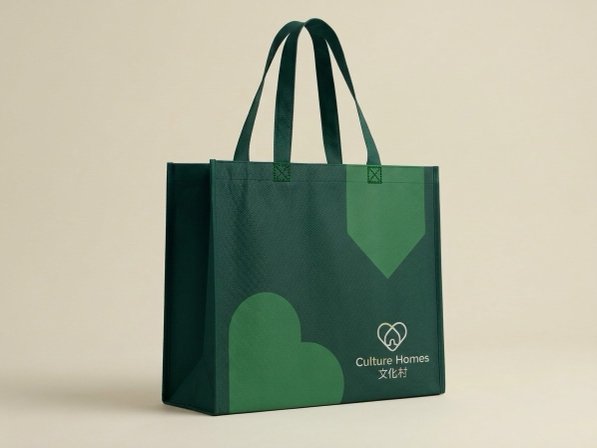
Prepared by Global Harvest Company · Updated 4 October 2026
What 80, 90 and 100 gsm mean
Non-woven bag specifications commonly describe fabric by gsm: grams per square metre. This measures fabric mass per unit area, not thickness itself. For our shopping-bag references, 80 gsm is a common option, 90 gsm is a heavier option, and the Culture Homes customer order shown here uses 100 gsm. Fabrics of the same gsm can still differ in structure and feel.
| 80 gsm | Common shopping-bag reference; assess size, intended contents and handle construction |
|---|---|
| 90 gsm | Heavier fabric option compared with 80 gsm; confirm the full bag specification |
| 100 gsm | Used for the featured Culture Homes order; review seams and reinforcement alongside fabric weight |
A heavier fabric can be part of a more substantial bag, but a gsm figure alone cannot establish a tested carrying capacity. For a heavy duty shopping bag brief, provide the intended contents and load so the finished sample can be assessed.
Match the print process to the logo
For a solid-colour logo, artwork planning centres on clear edges, colour coverage and print placement. A logo with shading, a smooth gradient or photographic details needs a process capable of reproducing those changes. The actual process is selected after reviewing the fabric, artwork and quantity; a photograph does not prove which process was used.
- Send the original logo artwork where available, preferably a vector file for line art and text.
- Keep a high-resolution original for gradient or photographic artwork; do not enlarge a small screenshot and expect it to become sharper.
- Provide the desired print width and height, number of printed sides and bag colour.
- Outline fonts or include agreed font information, and identify important brand colours.
- Review a proof or sample on the intended material. Screen colours and fabric prints may not match exactly.
The blue gradient-logo customer reference on the reusable shopping bag page shows why print planning matters. It is a product reference, not a promise that every design can use the same method.
Why handle and opening details matter
The handle attachment transfers the carrying load into the body of the bag. X-stitch reinforcement, the attachment area and appropriate seam construction help manage that stress. A folded, stitched bag opening and careful finishing are also relevant when a bag is used repeatedly.
The Lam Kee Seafood stitched order on the non-woven bag page and the Culture Homes 100 gsm case study provide real construction references. Neither image establishes a universal kilogram rating. Dimensions, handles, seams and intended contents should be checked together.
A better brief for a printed non-woven bag
- Bag width, height and gusset; whether customers carry it by hand or on a shoulder.
- Fabric weight, bag colour and any required lining or laminated finish.
- Artwork file, print size, sides and whether the design contains gradients.
- Contents, intended repeated use, quantity per design, destination and arrival date.
Send your specification for a quotation
Email the bag reference, dimensions, quantity, artwork and destination. If details are not final, start with the contents and intended use. Sampling, production timing, freight, currency and payment terms are confirmed for the project.
Email info@hongkongbag.com.hk WhatsApp +852 6228 7145Business enquiries and quotations are handled by Global Harvest Company(喜富達公司).